

NADRA Juvenile Card
The NADRA Juvenile Card is an official identity document issued to Pakistani children under the age of 18. It provides a secure identity record in the National Database and Registration Authority (NADRA) database. It serves as proof of the child’s identity and relationship with their parents or legal guardian. As identity verification becomes increasingly important for education, travel, and government services, obtaining a Juvenile Card has become an essential step for many families.
NADRA has introduced a straightforward procedure that allows parents or legal guardians to apply for a Juvenile Card through its Registration Centres. The process includes child registration, biometric verification according to the child’s age, document submission, approval, and fee payment before the card is issued. Understanding each step helps applicants avoid delays and complete the application successfully.
Key highlights include:
- Available for Pakistani citizens under 18 years of age.
- Issued after completing the required registration process.
- Requires the child’s presence for biometric capture where applicable.
- Can be applied for by a father, mother, or legal guardian.
- Available through NADRA Registration Centres and the PakID App, with some steps requiring a physical visit.
What is the NADRA Juvenile Card?
The NADRA Juvenile Card is an identity document designed specifically for children under 18. It is issued under Rule 18 of the NADRA (NIC) Rules, 2002, and serves as official proof of identity. Unlike the Child Registration Certificate (CRC), the Juvenile Card provides children with a formal identity card that includes biometric information based on their age group.
The card helps maintain an updated identity record in NADRA’s national database and supports identity verification for various official purposes. It also strengthens the connection between the child and their registered parents or legal guardian, making future identity-related processes smoother.
The Juvenile Card offers several benefits, including:
- Official identity document for children.
- Secure registration in NADRA’s database.
- Supports future identity verification.
- Can be used for various official documentation processes.
- Contains biometric information according to the child’s age.
NADRA Juvenile Card Eligibility Criteria
Every Pakistani citizen who has not reached the age of 18 is eligible to apply for a Child Registration Certificate (CRC) or a NADRA Juvenile Card, provided they meet the registration requirements. The eligibility is defined under Rule 18(1) of the NADRA (NIC) Rules, 2002, and Section 9 of the NADRA Ordinance, 2000.
Children born in Pakistan as well as Pakistani children born abroad may qualify for registration if they provide the required birth documentation. Before applying for a Juvenile Card, the child must already be registered in NADRA’s database. This ensures that the authority can verify the child’s identity before issuing the card.
Eligibility requirements include:
- Applicant must be a Pakistani citizen.
- Child must be under 18 years of age.
- Child must be registered with NADRA.
- Required birth documents must be available.
- Parent or legal guardian must complete the application process.
Difference Between CRC and NADRA Juvenile Card
Although both the Child Registration Certificate (CRC) and the NADRA Juvenile Card are issued to children under 18 years of age, they serve different purposes. The CRC is the child’s initial registration document in NADRA’s database, while the Juvenile Card functions as a formal identity card with additional biometric features based on the child’s age.
Parents often confuse these two documents because both are linked to child identity registration. However, the Juvenile Card provides a more complete identity document that can support future verification requirements and official record management.
| Feature | Child Registration Certificate (CRC) | NADRA Juvenile Card |
|---|---|---|
| Purpose | Initial child registration | Official identity card |
| Eligible Age | Under 18 years | Under 18 years |
| Identity Proof | Yes | Yes |
| Biometric Information | Age dependent | Age dependent |
| Issued By | NADRA | NADRA |
Age-Wise Biometric Requirements for NADRA Juvenile Card
NADRA captures different biometric details depending on the child’s age. Younger children require fewer biometric records, while older children undergo fingerprint and iris verification to strengthen identity security. These requirements ensure that identity information remains accurate throughout childhood.
As children grow, biometric information changes, so NADRA requires updated records at different age milestones. This approach helps maintain reliable identity verification while reducing processing issues in the future.
| Age Group | Photograph | Fingerprints | IRIS Scan | Expiry |
|---|---|---|---|---|
| Up to 3 Years (CRC) | Yes | No | No | At age 3 |
| 3 to 10 Years | Yes | No | Yes | At age 10 |
| 10 to 18 Years | Yes | Yes | Yes | At age 18 |
| Juvenile Card (Up to 10 Years) | Yes | No | Yes | At age 10 |
| Juvenile Card (10 to 18 Years) | Yes | Yes | Yes | At age 18 |
Important biometric requirements include:
- A photograph is required for every eligible child.
- Iris scan is required from the age of three.
- Fingerprints become mandatory from the age of ten.
- Child’s presence is mandatory for biometric capture where applicable.
Documents Required for NADRA Juvenile Card
Preparing all required documents before visiting a NADRA Registration Centre helps complete the application without unnecessary delays. NADRA verifies both the child’s information and the parent’s identity before processing the application.
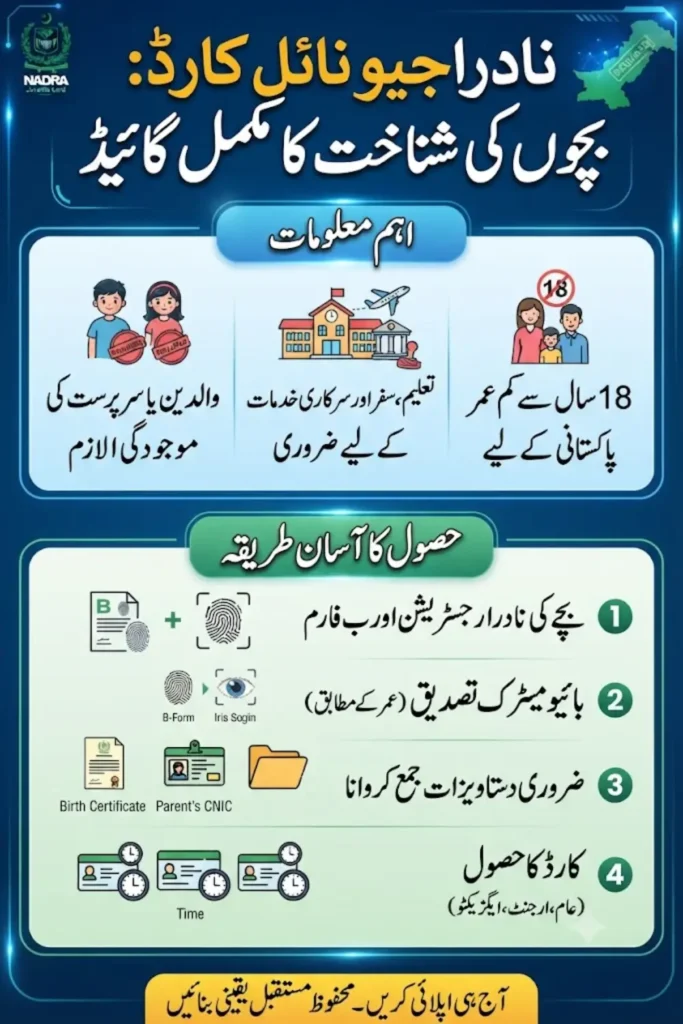
The authority also checks birth records and parental details to ensure that the child’s information matches the national database. If any required information is missing or incorrect, applicants may need to update their records before the Juvenile Card can be issued.
Applicants should keep the following documents and information ready:
- Computerized Birth Registration Certificate issued by the Union Council, Municipal Committee, or Cantonment Board.
- Detailed Birth Certificate or S-1 Form for children born abroad.
- Parent’s original CNIC.
- Child’s existing registration details.
- Parent’s fingerprints for biometric verification.
- Registered mobile number.
- Active email address.
- Details of the computerized birth certificate.
- Legal guardianship documents, if applicable.
Who Can Apply for a NADRA Juvenile Card?
NADRA allows the father, mother, or legal guardian to submit the Juvenile Card application on behalf of the child. The authority verifies the relationship between the applicant and the child before completing the registration process. This ensures that identity records remain secure and protected.
If the application is submitted by the mother or a legal guardian, the relevant applicant must remain present during the registration process to complete the required verification. The child’s presence is also mandatory because photographs and biometric information must be captured according to the applicable age group.
The following individuals may apply:
- Father.
- Mother.
- Court-recognized legal guardian.
Important conditions include:
- Child’s presence is mandatory.
- Parent or guardian must complete biometric verification.
- Correct family information must already exist in NADRA’s records.
- Required supporting documents must be provided.
Step-by-Step NADRA Juvenile Card Application Process
NADRA has established a simple registration process that allows parents and legal guardians to complete the Juvenile Card application through a Registration Centre. Each stage is designed to verify the child’s identity before the card is approved and printed. Applicants should carefully follow every step to avoid delays during processing.
The process begins with child registration in the NADRA database. After successful registration, the applicant receives a token to continue the application. At the registration counter, NADRA staff capture the child’s photograph and required biometric information according to the child’s age. The accompanying parent or legal guardian must also complete biometric verification before the data entry process begins. Once all details are entered, an approval officer reviews the application. After approval, the applicant pays the prescribed fee through the available payment method, and the Juvenile Card is delivered within the selected processing period.
Application process at a glance:
- Register the child in NADRA’s database.
- Receive the application token.
- Visit the registration counter.
- Child’s photograph and biometrics are captured.
- Parent or legal guardian completes biometric verification.
- NADRA staff enter the required information.
- Approval officer verifies the application.
- Pay the applicable processing fee.
- Receive the Juvenile Card within the selected delivery timeline.
How to Apply for a NADRA Juvenile Card Through the PakID App?
To make identity registration more convenient, NADRA also allows parents and legal guardians to start the Juvenile Card application through the official PakID App. The application lets users submit personal information, upload required documents, and track the application status from their mobile devices. However, depending on the child’s age and biometric requirements, applicants may still need to visit a NADRA Registration Centre for photograph and biometric capture.
Using the PakID App can reduce paperwork and save time by allowing applicants to complete most of the initial steps online. Before starting the application, make sure all required documents are available and the child’s information matches NADRA’s records.
Steps to apply through the PakID App:
- Download the official PakID App.
- Create a new account or sign in.
- Select “New Juvenile Card.”
- Enter the child’s personal information.
- Upload the required supporting documents.
- Visit a NADRA Registration Centre if biometric verification or a photograph is required.
- Track the application status through the app until the card is issued.
NADRA Juvenile Card Fee Structure and Processing Time
NADRA offers three different processing categories so applicants can choose a service based on their urgency. The fee varies according to the selected processing speed, while all services follow the same application procedure.
Applicants should select the service carefully before making payment because the processing time depends on the chosen category. Once the application is approved and the fee is submitted, the Juvenile Card is delivered within the prescribed timeframe.
| Service Type | Fee | Estimated Delivery Time |
|---|---|---|
| Normal | Rs. 750 | 31 Days |
| Urgent | Rs. 1,500 | 23 Days |
| Executive | Rs. 2,500 | 9 Days |
Before paying the fee, remember:
- Select the appropriate service category.
- Complete all verification steps.
- Submit payment through the available online payment method.
- Keep the payment receipt for future reference.
Important Rules Parents Should Know Before Applying
Parents and legal guardians should carefully review NADRA’s requirements before visiting a Registration Centre. Missing documents or incorrect information may delay the application process. Ensuring that all records are accurate helps complete the registration without unnecessary visits.
The child’s registration details, birth certificate, and parents’ information should already be updated in NADRA’s database. Applicants should also understand that biometric requirements vary according to the child’s age.
Important points include:
- Child’s presence is mandatory for Juvenile Card processing.
- Children above three years require biometric capture according to their age.
- Parents or legal guardians must complete biometric verification.
- The computerized birth certificate should contain accurate information.
- A registered mobile number and email address should be provided.
- Legal guardians must provide supporting legal documents where applicable.
Common Issues Parents May Face During the Application
Some applications require additional verification because of incomplete or incorrect family records. These situations can delay processing until the necessary corrections are made. Parents should verify all documents before submitting the application to avoid unnecessary complications.
NADRA also provides solutions for many special cases involving children born abroad, duplicate registrations, or incorrect family information. Updating records before applying usually speeds up the approval process.
Common situations include:
- Child is not registered with NADRA.
- Duplicate CRC records exist.
- Incorrect father’s name in the CRC.
- Parents’ marital status has not been updated.
- Child was born outside Pakistan.
- Only one parent is available.
- Father is a foreign national.
- Application is submitted through a legal guardian.
Renewal, Update and Reprint of NADRA Juvenile Card
A Juvenile Card may require renewal, modification, or reprinting if the document expires, contains incorrect information, or is lost or damaged. NADRA provides separate services for each of these situations through its Registration Centres and applicable online services.
Applicants requesting updates should provide supporting documents related to the required change. In case of a lost or damaged card, the reprint process allows parents or guardians to obtain another copy after completing the necessary formalities.
Available services include:
- Renewal after expiry.
- Modification of personal information.
- Correction of existing details.
- Reprint of a lost card.
- Replacement of a damaged card.
What Happens When the Child Turns 18?
The Juvenile Card is a temporary identity document that remains valid only until the child reaches the applicable age limit. Once the individual turns 18 years old, the Juvenile Card expires and can no longer be used as an identity document.
After reaching adulthood, the individual must apply for a Computerized National Identity Card (CNIC) according to NADRA’s procedures. Updated biometric information is collected during the CNIC registration process to create an adult identity record.
After turning 18:
- Juvenile Card expires.
- Applicant becomes eligible for a CNIC.
- Updated biometric information is collected.
- Adult identity record is created in NADRA’s database.
Benefits of the NADRA Juvenile Card
Obtaining a Juvenile Card helps establish a secure identity record for children from an early age. It also simplifies future verification processes because the child’s information is already available in NADRA’s national database. Parents can benefit from quicker identity verification whenever official documentation is required.
The card also strengthens the legal relationship between the child and the registered parents or legal guardian. Maintaining updated identity records helps reduce complications in future registration and identification procedures.
Major benefits include:
- Official proof of identity for children.
- Secure registration in NADRA’s national database.
- Easier identity verification.
- Supports official documentation requirements.
- Maintains updated biometric records.
- Confirms the child’s relationship with parents or legal guardian.
NADRA Helpline and Official Support
NADRA provides several support channels for applicants who need assistance during the Juvenile Card application process. Parents can contact the helpline for guidance regarding eligibility, documentation, application status, or technical issues related to registration.
Applicants may also visit their nearest NADRA Registration Centre for in-person assistance. Keeping the application receipt and registration details available helps the support team provide quicker assistance.
Support options include:
- Call NADRA Helpline 1777.
- Visit the nearest NADRA Registration Centre.
- Use the official PakID App to track the application.
- Visit the official NADRA website for updated information and services.
Frequently Asked Questions
1. Who can apply for a NADRA Juvenile Card?
The father, mother, or a legal guardian can apply on behalf of a child, provided all eligibility requirements are fulfilled.
2. Is a Child Registration Certificate (CRC) required before applying for a Juvenile Card?
Yes. The child must first be registered with NADRA before the Juvenile Card application can be processed.
3. Is the child’s presence mandatory during the application process?
Yes. The child must be present for photograph and biometric capture according to the applicable age requirements.
4. What documents are required for a Juvenile Card?
Applicants need the computerized birth certificate, parent’s CNIC, mobile number, email address, and other supporting documents if required.
5. How much does a NADRA Juvenile Card cost?
The fee starts from Rs. 750 for Normal service, while Urgent and Executive services cost Rs. 1,500 and Rs. 2,500 respectively.
6. Can parents apply through the PakID App?
Yes. Parents can start the application through the PakID App, although biometric verification may still require a visit to a NADRA Registration Centre.
7. What happens if the child was born outside Pakistan?
Parents must provide the required overseas birth documents, such as a Detailed Birth Certificate or S-1 Form, along with other supporting records.
8. What happens when the child turns 18 years old?
The Juvenile Card expires, and the individual must apply for a Computerized National Identity Card (CNIC).
9. Can a legal guardian submit the application?
Yes. A legal guardian may apply if they provide the necessary legal guardianship documents and complete the required verification.
10. How can applicants get help regarding their application?
Applicants can contact NADRA’s helpline at 1777 or visit the nearest NADRA Registration Centre for assistance.
Conclusion
The NADRA Juvenile Card is an important identity document that helps establish a child’s official identity before reaching adulthood. By completing the registration process, parents and legal guardians can ensure that their child’s identity is securely recorded in NADRA’s national database. Whether applying through a Registration Centre or starting the process via the PakID App, following the required steps, submitting accurate documents, and completing biometric verification can help avoid unnecessary delays.
With multiple processing options, age-based biometric requirements, and dedicated support services, NADRA has made the Juvenile Card application process more accessible for families across Pakistan. Keeping the child’s records updated from an early age also makes future identity-related services, including the transition to a Computerized National Identity Card (CNIC) at the age of 18, much smoother.